


Author

Willem, Romanus, Jozef VAN COTTHEM
Honorary Professor University of Ghent (Belgium) / Honorary Professor of the Antwerp University
Scientific Consultant for Desertification and Sustainable Development/...
Sacks gardening in urban and rural areas
25 Feb, 2010 12:22 pm


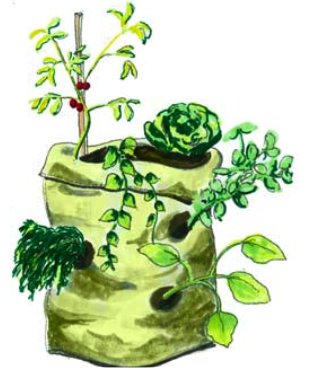
In every developing country people are suffering from the high food prices. More than billion people are hungry every day. The creation of small-scale kitchen gardens and container gardening are the most efficient tools to provide fresh food to rural farmers and urban people. Growing food in sacks is an interesting variant of container gardening.
 |
In every developing country people are suffering from the high food prices.
Taking into account that most of the rural women in the drylands spend the major part of their daily life with small-scale agricultural activities, it goes without saying that, when creating diverse and innovative partnerships that can help people and communities achieve greater productivity, the best return on investment will come from the creation of small kitchen gardens close to their houses. There is no need to offer them some financial resources. Funding to start up a family garden can be done as a “micro-credit”, not with a certain sum of money, but in the form of the necessary materials and equipment. Success stories have shown that, in rural areas, offering a family garden to women is the easiest and most efficient way to combat hunger and poverty.
However, in urban areas the situation is quite different. With their extremely low income and having barely a patch of arable land, almost all the urban families are confronted with some form of hunger and malnutrition. In Nairobi (Kenya), hundreds of residents of the slums have adopted a new form of intensive gardening: growing vegetables and herbs in sacks.
Previously, women in densely populated cities mostly planted vegetables on small plots of barren land. Nowadays, the novel form of gardening in sacks or all kinds of containers can be introduced in every urban area. Indeed, as finding even small patches of arable land in a city or a town is becoming almost impossible, sacks or other containers, taking up less space than small-scale gardens, are an interesting solution for food production.
With only a small budget, NGOs can easily start up a sacks gardening project with a small number of women and later extend invitations to more women, and even schools, to join the group. This seems to be a fantastic way for almost every urban family or school to have access to affordable vegetables, herbs and fruits.
Wherever needed, a short training in sacks gardening can be planned. Women and children can learn in the shortest time these simple gardening techniques of container gardening, in particular those of water harvesting, soil fertilization and adequate irrigation.
As sacks gardening can provide a sustainable source of vegetables and fruits, one can foresee a growing success of this novel form of gardening both in rural and in urban areas. NGOs and foundations can help women and schools to fence their gardening plots and to store irrigation water (not drinking water).
With a limited number of sacks of vegetables family members or school children do not fear to be hungry. It would be a remarkably easy way of food production in refugee camps, where every family could have a small number of sacks close to the tent.
The success of similar projects in developing countries on all continents should encourage NGOs, foundations, banks and international agencies like FAO, WFP and UNHCR to invest in this efficient way of combating hunger and poverty.
If there is really a growing international recognition of the role of agriculture and rural development in poverty reduction, helping to build the Global Partnership for Agriculture, Food Security and Nutrition, along with promises from world leaders of large additional increases over the next three years, like Secretary-General BAN KI-MOON said, then it should not be so difficult to set up a programme to promote sacks gardening at a global level.
Author
 Read more
By the same author

I've used re-usable grocery bags for growing vegetables with huge success. I've also read that Earthboxes are being used successfully in the developing world and are particularly good because they are extremely water efficient and need very little fertilizer.
Cans and sacks are never discarded but always reused for an inconceiveable variety of unintended purposes. There is no question, however, that there is not enough wealth to purchase even the most simple commodity.
What I like most about using sacks is that they can be easily sent in quantity to a destination village or project at very little cost to the sender!
Our task is to simplify the process to its least significant denominator. THEN, it has a chance for success.
I welcome anyone interested in participating in the execution of such a strategy to contact this prototype effort at: projectgarden@dimidia.com . This email address will be available by 18:00 Friday.
I am confident that Professor Van Cotthem will welcome our joint, creative efforts to join us in the selection of locations and garden contents.