


Author

Prof dr. L. Reijnders (1946) studied biochemistry at the University of Amsterdam and got his PhD in molecular biology from that university in 1973. After that he worked in teaching positions at the Agricultural...
A closer look at geochemical carbon management
24 Apr, 2009 08:55 am


In view of the ever more pressing problem of climate change, options to reduce CO2 emissions and to increase CO2 sequestration become increasingly important. Several of these options have been well studied, but some options have so far rather been interesting suggestions. The proposed use of finely ground silicate rock, which would lead to ?enhanced weathering? falls in the latter category.
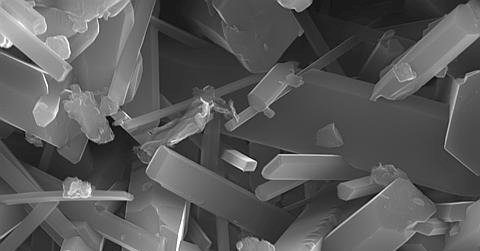 |
Silicates which have been proposed for this purpose include: olivine, serpentine and wollastonite.
Some have made strong claims for such ‘geochemical carbon management’. For instance, Schuiling and Krijgsman (2) have stated that 0.4 centimeter of olivine powder applied to the continents may sequester all atmospheric CO2. This is actually is not a good idea, because it would mean an end to photosynthesis. This in turn would lead to the extinction of all animals dependent on photosynthesis, including Homo sapiens. But the gist of what Schuiling and Krijgsman have in mind is clear: finely ground silicate rock is fit for large scale fixation of CO2. Hartmann and Kempe (3) have now had a closer look at the use of finely ground silicate rock and have found its potential much more limited than suggested by Schuiling and Krijgsman. They come up with the conclusion that finely ground silicate rock may in practice be able to sequester in the order of 0.1% of current global CO2 emissions. A main use would be the application of finely ground silicate rock for wet rice production.
It would seem useful to further investigate the application of silicate rock to wet rice cultivation. But the study of Hartmann and Kempe makes clear that for major solutions to climate change we should probably look elsewhere.
(1) Stephens, J.C., Keith, D.W. Assessing geochemical carbon management. Climate Change 2008; 90: 217-242
(2) Schuiling, R.D., Krijgsman, P. Enhanced weathering: an effective and cheap tool to sequester CO2. Climate Change 2006; 74: 349-354
(3) Hartmann, J., Kempe, S. What is the maximum potential for CO2 sequestration by ‘stimulated’ weathering on the global scale. Naturwissenschaften 2008; 95: 1159-1164
-
12/12/12
“Peak Oil” is Nonsense… Because There’s Enough Gas to Last 250 Years.
-
05/09/12
Threat of Population Surge to "10 Billion" Espoused in London Theatre.
-
05/09/12
Current Commentary: Energy from Nuclear Fusion – Realities, Prospects and Fantasies?
-
04/05/12
The Oil Industry's Deceitful Promise of American Energy Independence
-
14/02/12
Shaky Foundations for Offshore Wind Farms
Author
 Read more
By the same author

Please note the statement -
"(3) have now had a closer look at the use of finely ground silicate rock and have found its potential much more limited than suggested by Schuiling and Krijgsman. They come up with the conclusion that finely ground silicate rock may in practice be able to sequester in the order of 0.1% of current global CO2 emissions."
- is calculated for normal treatment amounts of mineral fertilization.
Schuiling suggests a treatment amount much higher.
With best regards, Jens Hartmann