
Has Peak Oil Been Reached? No!
5 Nov, 2007 12:51 pm
The Energy Watch Group released a report last week, stating that peak oil was reached in 2006. Scitizen sought the professional view of Dr Peter Jackson, Director of the CERA (Cambridge Energy Research Associates), whose position is that peak oil has not been reached. As well, we speak to Mr Jorg Schindler, the main author and Managing Director of Ludwig-Bölkow-Systemtechnik GmbH, about the report.
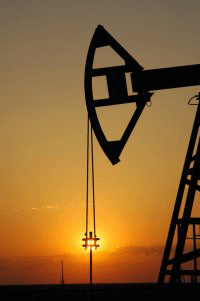
Peak Oil : IEA's predictions seeming more and more infeasible with time
On November 9, the Uppsala University in Sweden published a report titled "The Peak of the Oil Age - The Uppsala World Energy Outlook". The report performs an analysis of the oil production forecast done by the International Energy Agency in 2008. One day before the release of the IEA 2009 edition of its World Energy Outlook report, the team of researchers notably pointed to a world oil supply in 2030 some 26 Mb/d lower than the IEA's predictions. Dr Michael Lardelli, one of the co-authors of the study, answers Scitizen's questions.
Oil Optimists Grow More Outlandish
As the troubling realities of future oil supplies begin to penetrate official circles, the oil optimists are making even more outlandish claims.
The Influence of "Peak Oil"
An article in the Washington Post this weekend, together with a must-read interview in The Independent, a paper I used to read regularly when I lived in London, reminded me of an observation I made several years ago concerning the similarities between Peak Oil and Y2K. Having spent a fair amount of time in my former corporate role planning for the serious outcomes the latter might have produced, I don't intend this as a slam on the former. Without rehashing the technical arguments behind either phenomenon, it's worth spending a few minutes thinking about the consequences of a growing belief that we might be only a few years away from the end of oil, as we know it. Whatever one's take on the validity of the Peak Oil argument, it has already evoked noteworthy consequences, both positive and negative.
The Fed and peak oil
Laurel Graefe, a senior economic researcher working for the Federal Reserve Bank of Atlanta has written an excellent overview of peak oil, “The Peak Oil Debate”. I consider this a must-read piece, as much for armchair oil experts as beginners, and as much for who published this as what it contains. This should be very high on your list of “brother-in-law” documents, the ones you can safely recommend to co-workers, neighbors, or, well, your brother in law.
Which Matters Most? The Size of the Tap or the Tank?
Energy optimists are fond of citing very large numbers for worldwide fossil fuel resources such as oil and natural gas. But they conveniently leave out the critical variable. How fast can we actually produce these resources?
Peak phosphate
The peak in conventional oil and gas production is not the only peak in the supply of natural resources to be confronted in the near future. It seems likely that the peak in conventional phosphate production from phosphate rock may also be near. A recent study of Cordell and coworkers, which is in press (1), suggests that ‘peak phosphate’ may occur between 2030 and 2040. ‘Peak phosphate’ may cause a shock. This is all the more so because oil and gas can be replaced by other means of energy supply, but phosphate is without a substitute.
Gap Oil
It is Gap Oil not Peak Oil that is the problem. Rising demand for oil will exceed the quantity of it that can be withdrawn from the earth, resulting in a supply-demand gap. Once production does peak the gap will be enlarged from both sides, drawing down the supply side against rising demand. This I suggest should be termed "Gap Oil". Energy efficiency and a reduction in our demand for oil is paramount and a growing dependence on what can be grown, to create a sustainable "bioeconomy".
Has Peak Oil Been Reached? Yes!
The Energy Watch Group released a report last week, stating that peak oil was reached in 2006. Scitizen speaks to Mr Jorg Schindler, the main author and Managing Director of Ludwig-Bölkow-Systemtechnik GmbH, about the report. As well, we sought the professional view of Dr Peter Jackson, Director of the CERA (Cambridge Energy Research Associates), whose position is that peak oil has not been reached.
| [1] | Comment by Ron Steenblik (Global Subsidies Initiative)
- 5 Nov, 2007 11:52 pm I tend to agree with Dr. Peter Jackson's assessment of future oil production. But I am surprised to see him state that "the total liquids hydrocarbon inventory ... includes crude oil, condensate, NGL's, extra heavy oils and biofuels." What is the rationale for including biofuels with these other fuels in an "inventory" of hydrocarbons (unless one is counting only that which is available in storage at any given time)? |
Alert Moderator
| |
| [2] | Comment by Dr Luc Arnold - 13 Nov, 2007 05:52 pm I do not agree with Jackson's statement "The concept of peak oil is not reliable". The concept itself is reliable of course, otherwise it would mean that oil resources are infinite. The difficulty, due to the complexity of the problem, is to predict accurately *when* the peak will occur (or has it occurred recently?). The applicability of the concept is thus probably limited, I mean in term of accurate predictability as a physical law. But even if the peak oil (or a plateau) occurs in 2017 instead of now, obviously it will be followed by a decrease of oil production. I think this is the force of the peak oil concept, to just remind us that *there will be a decrease* with significant impacts on our societies. |
Alert Moderator
| |


Enlarge text
Reduce text size
Read the Energy Watch Group report and executive summary 


