


Author

Prof dr. L. Reijnders (1946) studied biochemistry at the University of Amsterdam and got his PhD in molecular biology from that university in 1973. After that he worked in teaching positions at the Agricultural...
The strange case of algal biofuels
29 Oct, 2008 12:19 pm
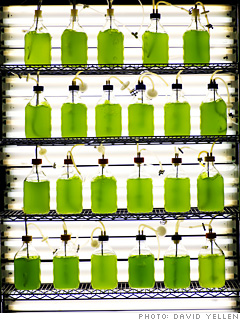
. The aircraft maker Airbus ?welcomes the idea?. The oil company Shell and the airline Air France are involved in the development of algal oil production, as are a number of start-up companies. I heard a representative of one of the start-up companies active in the field, Algae-Link, recently on the BBC Worldservice. He stated that algal biofuels are ?exciting because achievable? Algae-Link works with tubular bioreactors producing microalgae in greenhouses. Learned journals have now published a series of articles stressing the high productivity of algae in producing biofuels and their superiority to terrestrial biofuels. Media are also interested, and report the development largely as being awesome.
)


Algal biofuels are hot. The focus is on the production of algal oil (glycerol esters of fatty acids). The aircraft maker Airbus ?welcomes the idea?. The oil company Shell and the airline Air France are involved in the development of algal oil production, as are a number of start-up companies. I heard a representative of one of the start-up companies active in the field, Algae-Link, recently on the BBC Worldservice. He stated that algal biofuels are ?exciting because achievable? Algae-Link works with tubular bioreactors producing microalgae in greenhouses. Learned journals have now published a series of articles stressing the high productivity of algae in producing biofuels and their superiority to terrestrial biofuels. Media are also interested, and report the development largely as being awesome.
 |
Finally, it is also hard to see why airlines and Airbus are interested. At the low temperatures of cruising altitudes algal oils will freeze.
The supporters of algal biofuels are apparently very good in their public relations. But as yet no convincing case has been made that in the real world algal oil makes sense.
(1) R.R. Wijffels, Trends in Biotechnology 26 (2008) 26-31
(2) Y. Chisti, Trends in Biotechnology 26 (2008)351-352
(3) C.Jimenez et al. Aquaculture 221 (2003) 331-345
(4) J.R. Benemann et al. Greenhouse Gas Control Technologies – 6th International Conference 2003 14433-1438
-
12/12/12
“Peak Oil” is Nonsense… Because There’s Enough Gas to Last 250 Years.
-
05/09/12
Threat of Population Surge to "10 Billion" Espoused in London Theatre.
-
05/09/12
Current Commentary: Energy from Nuclear Fusion – Realities, Prospects and Fantasies?
-
04/05/12
The Oil Industry's Deceitful Promise of American Energy Independence
-
14/02/12
Shaky Foundations for Offshore Wind Farms
Author
 Read more
By the same author

When you see algae oil developers focusing on, and giving information on - their production costs per gallon of salable fuels (rather than yields of oil per unit area) then you know a competitive algae fuel production technology is at hand. To some what paraphrase your conclusion, the algae oil developers could use a lot less PR people and a lot more economist. The challenge in algae based fuel development isn't limited technology - it's limited economic understanding by the would be algae oil developers and especially their eager, but naive investors.
Thus algal biofuel is subject to the same potential limitations that agriculture is in general, since the world peaked in rock phosphate production 20 years ago. To proceed in this endeavour and in agriculture in general it will become necessary to recycle N and P from animal and human waste and biochar may help as a soil amending agent that causes the soil to hold fertilizers more firmly than in its absence, thus requiring less of them to be applied in the first place.
I am also puzzled about the viscosity problem of "biodiesel" derived from algae or from other plant oil, when a plane is flying in the frigid conditions of the troposphere. At -50 deg. C thus material would become too thick to pump, unless the fuel tanks are kept warm.
It is possible to crack such oil into hydrocarbons but of course the process then becomes more complex and energy intensive, not to mention the extra engineering necessary and on a stupendous scale.
I like very much the idea of algal biofuels but it seems to me that a solution to petroleum depletion is not thus provided as yet by them. We get through 30 billion barrels of crude oil a year and about 85% of that is used for fuel, and 65% of it for transportation.
Chris Rhodes.
With respect to algae produced biofuels, I am also concerned about "electricity" and/or "cooling" requirements not being fully included in the balances and estimates. Photosynthesis is, at best, 5% efficient, meaning 95% of the incoming solar must be removed as "waste heat'. The only device of accomplishing this removal efficiently (while producing electricity) is the Atmospheric Vortex Engine, which can do this on a "dry" basis using heat exchange with the atmosphere, in locations where evaporation of water from the process is a concern (i.e., any arid region).
Bottom Line: The AVE (http://vortexengine,ca) would be a necessary companion technology for the production of liquid fuels from ANY source, if this is to be accomplished effectively and economically.